Course: Science Fiction & Religion
Lecture #7: Theology on Other Worlds II
This week we will do several clips of different understandings of theology as shown on several different shows.
Because of its massive popularity and religious overtones, we will spend about half the class on the STAR WARS TRILOGY. I have about 40 minutes of clips from the three movies, most from "The Empire Strikes Back" since this is where Luke learns about being a Jedi warrior, and Yoda, the master, is his teacher.
The second half will consist of clips from 3 TV shows. One from ST: NG called "Half a life", the next from Bab 5 called "the Believers" and finally, One from the new Voyager series called "Emanations".
STAR WARS
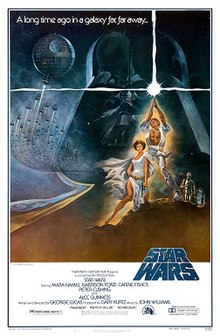
This massive work by George Lucas draws extensively from his own understanding of religion, mainly of Chinese Taoist ideas, and as filtered thru Joseph Campbells work, mainly, The Hero with the thousand Faces.
There are so many mythological themes in these movies it is impossible to discuss them all so I will focus on the idea of the Force.
The closest idea in Earth religion to the Force is the concept of the Tao in China. The Tao simply means nature, or the Way, which is the literal translation. The Tao interpenetrates everything, surrounds everything, and can be experienced thru meditation.
The concept of the yin/yang is also part of this religion. This is the balance that is maintained in all things. It is shown by a circle, half black half white, but each side contains a little of the other. When a thing is balanced, there is health. Tai Chi is used to keep the balance so the Chi, ie the wind of life or creation, can flow thru a person without interruption. If something blocks the Chi, a person can become ill, mentally or physically. So in a sense it is the Chi that can be called the force, but it takes the Tao to produce it.
SHOW YouTube “Jediism (15 min) – LINK
Jediism -- From Wikipedia, the free encyclopedia
Jediism is a nontheistic religious movement mainly based on the depiction of the Jedi in Star Wars media. Jediism attracted public attention in 2001 when a number of people recorded their religion as "Jedi" on national censuses.
Jediism is inspired by elements of Star Wars, namely the fictional religion of the Jedi. Early websites dedicated to bringing up a belief system from the Star Wars films were "The Jedi Religion and regulations" and "Jediism". These websites cited the Jedi code, consisting of 21 maxims, as the starting point for a "real Jedi" belief system. The real-world Jediism movement has no founder or central structure.
Beliefs
Although followers of Jediism acknowledge the influence of Star Wars on their religion, by following the moral and spiritual codes demonstrated by the fictional Jedi, they also insist their path is different from that of the fictional characters and that Jediism does not focus on the myth and fiction found in Star Wars. The Jedi follow the "16 teachings" based on the presentation of the fictional Jedi, such as "Jedi are mindful of the negative emotions which lead to the Dark Side" and "Jedi are guardians of peace and justice". Adherents also follow "21 maxims"
Census phenomenon
Jediism received press coverage following a worldwide email campaign in 2001 urging people to write "Jedi" as their answer to the religion classification question in their country's census, resulting in the Jedi census phenomenon. The majority of such respondents are assumed to have claimed the faith as a joke.
Legal recognition
During the drafting of the UK Racial and Religious Hatred Act, an amendment was proposed that excluded Jedi rights from any protection, along with Satanists and believers in animal sacrifice. The amendment was consequently withdrawn, the proposer explaining that it was "a bit of a joke" to illustrate a point that defining religious belief in legislation is difficult.
In 2007,23-year-old Daniel Jones founded The Church of Jediism with his brother Barney, believing that the 2001 UK census recognized Jediism as a religion, and that there were "more Jedi than Scientologists in Britain". In 2009, Jones was removed from a Tesco supermarket in Bangor, North Wales, for refusing to remove his hood on a religious basis. The owner justified Jones's ejection by saying, "He hasn't been banned. Jedis are very welcome to shop in our stores although we would ask them to remove their hoods. Obi-Wan Kenobi, Yoda and Luke Skywalker all appeared hoodless without ever going over to the Dark Side and we are only aware of the Emperor as one who never removed his hood."
In 2010, a man who described himself as a "Star Wars follower" and "Jedi Knight" was thrown out of a Job centre in Southend, Essex, for refusing to remove his hood, and later received an apology. The man said that "The main reason is I want to wear my hood up, and I have got a religion which allows me to do that."
In 2013, the Free Church of Scotland expressed concern that a proposed Marriage and Civil Partnership bill would "lead to Star Wars Jedi marrying couples". Patrick Day-Childs of The Church of Jediism, and Rev Michael Kitchen of Temple of the Jedi Order, both defended the right of Jedi to perform marriage Ceremonies.
In April 2015, the students of Dokuz Eylül University in Turkey started a petition on Change.org demanding a Jedi temple be built on the campus. The petition was in response to a previous petition which had demanded a mosque on the campus of Istanbul Technical University (İTÜ). The petition demanding the mosque reached 180,000 signatures falling short of its 200,000 targets and invoked a response from Mehmet Karaca, the rector of Istanbul Technical University (İTÜ), promising "a landmark mosque". Soon after, students from other universities started petitions demanding Jedi and Buddhist temples on their campuses.
In December 2016, the Charity Commission for England and Wales rejected an application to grant charitable organization status to The Temple of the Jedi Order, ruling that the group did not "promote moral or ethical improvement" for charity law purposes.
HALF A LIFE

"Half a Life" is the 22nd episode of the fourth season of the American science fiction television series Star Trek: The Next Generation, the 96th episode overall. It was originally released on May 6, 1991, in broadcast syndication. Director Les Landau said that "Half a Life" was a morality play about "how society deals with the elderly".
This episode staring David Ogden Stiers and Majel Barrett raises several issues of ethics.
David is a scientist trying to find a way to save his dying sun before it is to late. His experiment is a failure but he must go home to die at the age of 60, as it is his peoples tradition. This is called the Resolution. This upsets Lwaxana Troi a great deal and he decides to seek asylum. However, he is no longer allowed to work on his project.
Finally, after pleading from his daughter, he decides he must go home and be wined and dined and commit suicide.
Here are af few crucial scenes from this story: LINK (9-minutes)
DISCUSSION / QUESTIONS: Are nursing homes on ethical solution?
Does this Resolution make sense?
BELIEVERS
This deals with the belief system of a world, till then unknown to humans, that comes in conflict with human beliefs.
The doctor has a serious ethical dilemma and resolves it the only way he honestly can.
SHOW: Clips -- Bab 5: 15 min
DISCUSSION / QUESTIONS: Did The doctor do the right thing?
What does it mean to be "chosen"?
The idea of losing one’s spirit when cut open. Is this similar to the fear some native peoples have had about losing their spirit if someone takes their picture?
Are There False Religions in the ultimate sense?
EMANATIONS

This episode (Sar Trek: Voyager, 15 min) concerns a crewman who is inadvertently taken to this planet thru a natural phenomena, which occurs every 6 hours, and which gives rise to the belief system found here. The woman who ends up on Voyager cannot accept what has happened but some of her discussions are enlightening concerning their beliefs.
SHOW: Clip – Star Trek Voyager Emanations, 15 min
DISCUSSION / QUESTIONS: Given the context of this natural phenomena, one can see how they developed the idea that the whole person went to the next life.
How does this idea relate to the Jewish or Jehovah Witness idea that a person lies in the grave till the judgement day and there is no spirit that leaves the body?
Is this the same idea, that to be a whole person, one needs a body? This is certainly the Jewish ideal. It is the Greeks who developed the idea of a Spirit IN a body.
How does this relate to religion as you know it or are aware of it?
A Case of Conscience
In the case of James Blish, A Case of Conscience, we are dealing with a case of a planet with sentient life forms, reptilian, who have never developed a religion.
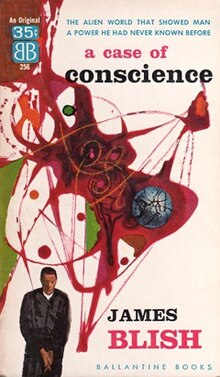
The question he raises, is how would we from earth, particularly a religious person, in this case a Jesuit priest biologist, react to creatures who are better than us? who are free from original sin? Who don't need or have religion?
Lithia is such a place.
There is no crime, no newspapers, no household communication systems, no arts separate from crafts, no political parties, no public amusements, no nations, no games, no religions, (gods, myths, legends, traditions, taboos or faiths).
They have never had a glacial epoch or change of climate in 700 million years. In effect, they have never left the garden of Eden and do not share the burden of original sin.
They keep the highest ethical code w/o constraint or guidance -- everyone obeys as a matter of course. Father Ruiz Sanchez sees that they live perfectly.
His conclusion: They are a planet and people propped by Satan. The reasons he gives are that for the Lithians first, reason is always a sufficient guide, second The self-evident is always the real, third: good works are an end in themselves, forth: faith is irrelevant to right action, fifth: right action can exist w/o love, sixth: peace need not pass understanding, seventh: ethics can exist w/o evil alternatives, and eighth: morals can exist w/o conscience.
His vote then is that anything more to do with them is like living in Hell so only solution is no relationship with them.
DISCUSSIONS / QUESTIONS:
What do you think of this reaction? Do you think this is the way Christians, (or Jews or Moslems) would react to perfect, unfallen beings?
Is this paranoid?
What does it say about people of Earth?
Battlestar Galactica
From article “Born-Again 'Battlestar'” published on Beliefnet

Drawing from Mormonism, Roman polytheism, and even Buddhism, the reimagined sci-fi TV series is steeped in religion.
Once lambasted as a prime-time "Star Wars" knock-off, "Battlestar Galactica" has been reincarnated as an edgy, moody human drama. A "reimagining" of the original 1978 series, the current incarnation follows the survivors of the "twelve colonies of man" as they search for the mythical planet Earth following an apocalyptic sneak attack by the Cylons, a mechanical race created by human beings.
Brought back first as a mini-series in 2003, the show debuted on the Sci Fi Channel in 2005 with 3.1 million viewers, making it the network's most-watched premiere.
While fans of the original series may notice some changes to familiar characters-Starbuck is now a woman and the Cylons no longer look like toasters-the truly devoted will also note a change in the show's theology.
Theology?
That's right. Amidst spaceship shoot-outs, bizarre love triangles, and sketchy political maneuvering is a great deal of theology and religious reflection in the show's writing.
Debates about sin and redemption? Philosophical Inquiries Into religio-political motivations? The idea of the legitimacy of the soul? The battle between monotheism and paganism? Holy lands and prophets?
But that's really nothing new for the "Galactica" series.
Unbeknownst to most viewers, "Battlestar Galactica" has been steeped in religion since its very inception. First pitched by uber-producer Glen A. Larson as a series of Bible stories set in space called "Adam's Ark," the reworked "Battlestar Galactica" was also influenced by another religious book: the Book of Mormon. A member of the Church of Jesus Christ of Latter-day Saints, Larson borrowed plot points from his faith's sacred texts.
“Battlestar Galactica' and the Book of Mormon both start from the premise that civilization Is either about to be destroyed or has just been destroyed and that there's this remnant, this ragtag fleet that is preserved. The story of the Book of Mormon is set in the time frame of the destruction of Jerusalem. The prophet Lehi has a vision of the destruction of Jerusalem and was able to get his family out in time."
“There are many other similarities between the show and the Latter-day Saint scripture. While not purely a Mormon concept, the Idea of the "Lost Tribes of Israel"--that ten tribes of Israel were "lost" to history after they were exiled--plays an important role in both the religion and in the show. "The idea of there being these other civilizations that have the gospel is a main tenet in Mormonism. There is this idea, in the show, that Earth will be this colony that they don't have a record of, but they believe it exists."
Additionally, on the original series, the ruling colonial governmental body was known as "The Quorum of Twelve," the name given to the top leadership council of the Church of Latter-day Saints. Perhaps the most obvious parallel between Mormonism and the show is the Kolob/Kobol connection -- Kabol on 'Battlestar Galactica' is where the gods live and in Mormonism Kolob is supposed to be the greatest star in the universe and Is the dwelling place of God."
While developer and executive producer Ronald D. Moore did not intentionally move away from the original show's basic Mormon cosmology in the current incarnation, he chose not to expand upon It.
"I was aware that Glen had used Mormon Influences and how he had created the cosmology, but I'm not that familiar with Mormon belief or practice so it was kind of like whatever was in the show is what I was dealing with," concedes Moore, who also worked on the "Star Trek" franchise. "I essentially looked at the original series as mythos and the way It dealt with religion in sort of a global sense."
Taking inspiration from a post-9/11 world, the religious universe of the new "Battlestar Galactica" is as diverse and as complex as our own.
The refugee humans, the Colonials, are polytheists in the mold of the Romans and Greeks, while their creations, the mechanical Cylons, have a strict belief in a singular God and in the soul, and are on a mission to eradicate the non-believing humans.