Course: Science Fiction & Religion
Lecture #5: Theology Through Time & Space
We will be dealing with several stories, all quite different yet with the unifying theme of COMMITMENT. Be watching as we do these for how that is worked out as well as for other themes that crop up.
I will also give more background where it is appropriate, for example, on the Emigrant we will need some background on the Levitical priesthood.
I will ask for 2 of the stories to be read rather than give a synopsis, since they are short. The Emigrant and Proselytes by Gregory Benford.
We will discuss them as to theme, meanings, etc.
2nd hour we will see clips from movies that deal with commitment and Fanaticism. Pi and Handmaids tale.
ORDER;
- THE STAR -- We will begin with "THE STAR' written by A. C. Clarke in 1956 and won him the Hugo award for best short story that year. This rasies the problem of religious doubt to a man who felt space travel could never affect his faith.
- THE EMIGRANT
- WHEN JESUS COMES DOWN THE CHIMNEY
- THEOLOGY OF WATER
- PROSELYTES
THE STAR -- by Arthur C. Clarke
This story is told from the viewpoint of a Jesuit priest who is considering what he as, chief astrophysicist and his team, most of whom are not religious, have found in the Phoenix Nebulaw.
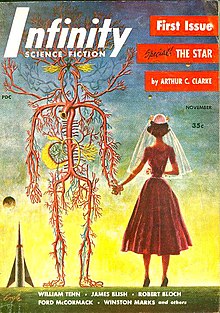
They are 3000 light years from Earth, and it is the year approximately 2500 CE or so. He and his team have discovered some truth which upsets him and which he fears will end the Jesuits thousand-year history and maybe much more than that. The Jesuits were founded in the mid 16th century by Ignatius Loyola, to whom he addresses his concern. a SUPERNOVA occurs about 3 times every thousand years or so. This is an explosion which is much more than a normal nova and creates a brilliant light in the sky. The Chinese saw one in 1054, though they were unaware of what it was, and another was seen in 1572.
The mission of this ship was to visit the remnants of one such supernova and learn its cause. They chose the phoenix nebulae but had no idea of the age until they arrived there. This one had occurred about 6000 years earlier.
In exploring, they didn't expect to find any planets, but they discovered one at an immense distance, the Pluto of this vanished solar system--to far from that sun to have known life.
They landed there and found a vault that was obviously the work. The vault was built by a civilization that of intelligent beings. knew it was about to die. They had years to prepare and collect and ana bury all the fruit of their genius hoping someday someone would find it and they would not be utterly forgotten.
They could travel in their own solar system but could not yet cross the interstellar gulfs of space.
They were humanoid, as shown by their sculpture, and the thousands of visual records and machines for projecting them. From this the explorers got a picture of an advanced civilization as well as enough data to learn their written language.
The Jesuit's colleagues question why, if God is merciful, this civilization destroyed in the full flower of its achievement?
He believes his colleagues will answer that the universe has no purpose or plan and since a hundred suns explode in our galaxy every year, some race is dying at any moment. It makes no difference if that race is good or evil for there is no God and thus no divine justice.
However, he realized God doesn't have to justify his actions but can create or destroy when He chooses. It is arrogance to argue with God's decision or to say otherwise.
He says he could accept that, but because of the calculations before him, his faith falters. For he realizes that this particular supernova was the Star of Bethlehem and he must question why God would destroy a civilization to produce that symbol.
NOTES ON "THE STAR" - We must realize that A. C. Clarke is basically negative as far as Christianity, or other western religions, are concerned. In fact, he lives in Sri Lanka and seems to lean toward the THERVADA SCHOOL of Buddhism which says there is no one to help one achieve enlightenment, neither men nor gods.
For the Buddhist, enlightenment means to be free of desire by following the' eightfold noble path. Only then will one cease to suffer.
I say this only to show his viewpoint but this should not detract from the story or the idea involved which calls into question the ethics of God.
How do you react to this idea?
I feel there are some underlying assumptions here based on the Eastern idea of Karma, which would say we earn in previous lives what we get. However it also assumes reincarnation in the East. I would like you're input about that.
THE EMIGRANT -- BACKGROUND
Priests in the Hebrew scriptures are representatives of the whole nation of Israel,
The whole people were to be holy to God but since that was an impossibility, the tribe of LEVI was set aside to be holy (Lev 11:44ff, Num 15:40)
THREE FOLD HEIRARCHY
All Levites are not equal:
The LEVITES were the lowest level, set apart for service in the sanctuary, they represent the people of Israel as substitutes for the firstborn sons, who belong by right to God. (Num 3:12-13, 41,45) Exod 13:2, 12 -13; Lev 27:26, etc.)
SONS OF AARON are above these and specifically consecrated for the specific office of priest. They alone represent the nation in the sacrificial ministrations of the alter.
THE HIGH PRIEST (Exod 28:29) bears the names of all 12 tribes on his breastplate. He alone can enter the Holy of Holies, and that only once a year on the DAY OF ATTONEMENT to offer sacrifice for himself and all the people (Lev 16:1-25)
In regard to our story THE EMIGRANT the priest is isolated from death, even of his relatives. (Lev 21:1-15)
The Israelite obsession with death was that death imparted a most severe impurity (Num 19:11-19). And if one was a priest, it was very much forbidden.
This may have been a violent rejection of the Egyptian religion that the dead and his burial place were equal to the temple in their sanctity.
THE EMIGRANT -- SYOPSIS 1980 by Joel Rosenberg
Yisro el Cohen, age about 30, a member of the Hasidim, one of the present day Jewish mystical groups and also an ORTHODOX JEW.
He is of the tribe of Levi and beard the name COHEN which makes him a member of the cohenim, priest of ancient Judea.
The cohenim are still the first ones called to go to the alter and read from the Torah each Sabbath.
He is a butcher by trade, a SHAYCHET who knows how to butcher the meat so it is kosher.
He is the 3rd generation after the holocaust, living in the year 2000, on the Christian Calander, or 5750 on the Jewish.
The context of the story is in giving explanation to his brother-in-law, Morin, who is a catholic, why he must leave.
As he says, for the catholic, the final authority is the pope but for the Jew is is the law, or the TORAH.
He relates the history of these century beginning with Hitler's election in 1933 when 10 million or so Jews lived in Europe.
Yisro el has never been to any of the camps because it is forbidden for a Cohen to enter a graveyard.
However, the ashes from all those burned in the crematoria have been spread by the wind all over the world. Every time people breath they are breathing in traces of all those killed and burned.
He says he must leave for since the world itself has become a graveyard he, as Cohen, must not stay on Earth but will go to a colony on the moon as a butcher.
Question: Is he right? or is he overreacting? Is this also a commentary on our ecological problems?
"WHEN JESUS COMES DOWN THE CHIMNEY" by Ian Watson
Summary
This next story brings up the issue of what can happen to truth given enough time and imagination. The crucial thing here is given the time between the events and the recording, if any of these events, what can happen to the real story. This is exaggerated, of course, but the fact is that the gospels were set down at least 2 generations after Jesus life and death and I believe he wants to make the point that there could be fallacies in the story, though not as blatant as this one.
Father tells son the story of when Santa was born in a stable and the 3 magicians hiked a thousand miles to be there when he was born. The follow a bright comet in the sky and bring a magic sack as a gift.
Santa's mother, to prevent jealousy by the neighbors and to keep the greedy emperor from getting it, hides it.
When Santa became a man, she gave it to him. He decided to shower presents from the sack on the country folk, though not ever take anything out of it for himself.
So he began tramping around giving people what they wanted or needed. Even so, others asked for things (a fur lined coat, a pair of black boots) and make him take them. Food was also pushed on him so he became very stout.
The romans arrested him as he was de-stabilizing a marginal economy. He was crucified with the sack over his head. When dead he was stuffed into his sack and buried by his friends in a tomb.
When robbers broke into the tomb to steal the sack, it was empty, as if it had swallowed him. The robbers were awed and began to spread the word @ Santa all over the world, carrying snippets of his sack with them as proof.
Most of the sack ended up in Torino (Turin?) where it remains to this day. Thus when everyone hears of Santa and loves him, the sack will again distribute free gifts.
On Easter, gifts are distributed wrapped in sack cloth in memory of Santa.
STORY OF JESUS
Tonight, the father says, is the one important to Jesus.
He was the leader of those thieves who broke into Santa's tomb. "Robbery" he says, "is the product of a society where there aren’t enough gifts to go around- or where there are too many gifts for too many people."
Jesus is the one who carried the sack to Roma where he went straight to the senate and began preaching: (quote on page 92).
"Your desires are the thesis. This sack is the antithesis. The synthesis is that you should empty yourselves of false goals, vain dreams, the products of a diseased society. Just you empty all of that false consciousness of yours into this sack! It will hold everything, and reduce everything that is contradictory. In its place you'll discover that gifts ought to be given according to one's needs, not one's desires--but society at present is based on legalized theft, on the alienation of persons from their soil, from their work, even from their own bodies and sexuality."
I believe this is Watson's thesis. How do you react to this statement?
It has more to do with Buddhist teaching than with what Jesus taught. Do you agree?
Soon many plebians began to believe him and stepped into the sack and out as a sign of a change of heart.
The emperor took notice, going to the forum intending to spear Jesus, but on the way had a vision seeing a sack in the sky which swallowed the sun (probably a total eclipse). On arrival he stepped into the sack and the empire became a republic. (This is, of course, Constantine in 312 CE)
Tonight Jesus will come down the chimney and take away whatever you think is most precious to you. This is how other deserving children receive gifts at Easter.
Jesus will redistribute all our wealth. He brings Santa's sack empty down every chimney and fills it full from every house.
I think there are several purposes in this story, which is one of the reasons I used it.
First, we have Watson showing what can happen to a story, any story, given enough time. This story takes place, presumably, in some far future when Santa has become more important than Jesus. The ultimate commercialism. Is this possible? Or has it happened already? Is this a comment on our consumer society?
Also, given that the first stories of Jesus were not written down until between 70 and 90 CE, at least 2 generations after his death/resurrection, I think he is saying that we can't totally rely on what is considered the "gospels". Things get exaggerated, used for polemical purposes, etc. With any oral tradition, as we all know from the game of "gossip", things can change over very little time, much less over a long period.
THESIS I believe is his statement given as preaching of Jesus. It has more to do with Eastern thought, especially Zen Buddhism, than with what Jesus taught.
What do you all think?
Can you see any other purposes for this story?
THEOLOGY OF WATER -- SUMMARY - 1980 - Hebert Schenck
NASA sends a team to Titan, one of Saturn's moons, to look for life.
The team is made up of comd. Brunel, an astronomer and pilot, Dr. Bateson, a chemist, Dr. Feeney a Jesuit priest and geophysicist, and Dr. Takoa a Japanese American exobiologist.
- Found water that froze at -67.1 Celsius (instead of 0)
- Earth water and Titan's water's curve matched exactly
- Titan ice floated higher than normal ice, thus lower density
Fr. Feeney predicted exactly how titan's water would behave then tells his baffled fellow team a story of a fellow Jesuit, Fr. Fullerton, whose doctoral dissertation predicted the way water would behave on every kind of planet. His dissertation was nicknamed "the Theology of water."
He varied the water properties for our given Earth then tried the true water properties on planets at different locations, with different masses.
The tilt of the Earth makes all the difference as to what happens to the properties of water. If the Earth were exactly straight, there would be too much stability, constant cloud cover, and ice caps down to latitude 40 degrees north and south.
If the polar axis is flat, as Uranus, there would be wild storms constantly.
Conclusion: the properties of water on earth were geared to us humans, beings that operate at 98.6 deg. F.
- The chances of a water-optimized Earth occurring in our galaxy was so small. Earth was it.
- Fullerton's conclusion was that we on Earth were all there was anywhere. This depressed him so much he committed suicide.
Fr. Feeney quit the university, went to retreat in NM and then joined NASA.
Even though Schenck disclaims that Fullerton uses the dissertation to refute Copernicus, he in fact does just that by saying the creation is for us humans. When we arrive at a planet, it will change to suit humans so humanity is still the center of the universe.
NOTE: Highlighted section is “Additional Material – Read only if Time & Interest Permit
His approach is basically gnostic for he says to be a saint is to KNOW. This is not the Christian definition of sainthood for most saints did not feel the knew.
This has the same problem that Gnosticism originally had. Ie, some people are capable of knowing and thus are saved while others were believed to not be capable of this knowledge and thus had no hope of salvation.
PNEAUMATICAS where those spiritual humans who when given the knowledge that leads to salvation would automatically accept it and be saved.
PSYCEKOS are those humans who were "soulish" (as opposed to spiritual) who might be saved but it would take a lot of work to learn the knowledge (gnosis) necessary for salvation. however, they at least had hope.
HYLIKOS were those who were carnal, so much so that they had no hope of salvation. this scheme was developed by Valentinius in the 2nd cent and was rejected by the church in favor of belief in Christ not a particular knowledge that could be acquired.
Thus Hilbert Schenck uses the science fiction genre to promote his own religious ideas rather than dealing with science fiction.
However, Dr. Takoa sees another interpretation. IE, the Earth's water was specifically designed for it as Titan's water was for it.
They run another test on Titan's water, what they had distilled earlier. They find it is now identical to Earth's water.
Feeny theologizes. God designs each world, though on most nothing
comes to live, but when humans arrive on Titan, they are the life and he has given Titan, its water and everything to them.
God is Johnny Appleseed preparing orchards across the 'universe and changing them when a different seed comes by.
Feeny understands how one becomes a saint: you KNOW. they checked the ice sheet again, pulling a sample. Earth water again -- something has changed the entire planet.
Finally, hundreds, maybe thousands of other groups were making the same discovery and responding the same way this group did, with awe. The entire universe was constantly pierced by bright, new as rows of surprise, love and joy.
This story is using a scientific context and then suspending science in favor of "bright arrows of surprise, love and joy."
It handles science in an entirely different manner so the basic premise about science is dramatically different from most. Traditional Science Fiction
Comments?
PROSELYTES -- by Gregory Benford, Late 80s
One of the finest hard Science fiction writers, he has won the nebula Award twice, as well as the British Science Fiction award and others. This story is a change of pace for him.
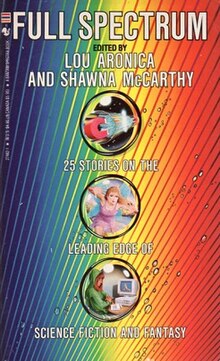
SYNOPSIS: Seven foot tall beings called Gacks have arrived and are bringing the "glorious word from the stars" and the "True knowledge of the Universe".
They arrived in asteroid shaped ships using the simplest methods, small nuclear bombs exploded out the back. In return for allowing them to speak, they will share their technology. Unfortunately, Earth is already ahead of them since they still use vacuum tubes, hand crank computers, etc.
They are analogous to the Jehovah's witnesses and Mormons, passing out literature and giving their spiel.
At one home, after listening to their spiel, Dad slams the door and comments that the only kinds of aliens who're damn fool enough to spend all their time flying to the stars are not explorers. not scientists. but fundamentalist.
Suddenly the sky is alive with darting ships blowing up the Gack Ships. They are sleek, shiny vessels, and junior says: "That’s what an alien starship oughta look like."
A banner unfurls from one of the ships reading: GREET THE CLEANSING BLADE OF THE ONE ETERNAL TRUTH"
Huh! says Junior, Dad's face goes white, and he says: "we thought the Mormons were bad, whoever thought there might be Moslems?"
This story is in the realm of what if: What if the first contact with an alien or more than one alien civilization turns out to be not scientists or explorers, but religious fanatics determined to convert humans to the "one true and right way?"
Worse, what if their philosophy is "convert or die?"
Questions: What, if any is the overarching theme of these stories?
COMMITMENT IN OUR STORIES
"The Star", of course, has a very committed Jesuit, who thinks there is nothing that can hurt his faith in God. However, upon discovering that the super nova which became the star of Bethlehem destroyed a whole civilization, he is not only shaken, but believes that all those of his order, and for that matter. most Christians, will in some degree or another, lose their faith.
The opposite number to this story is "Theology of Water" in which the Jesuit, who is losing his commitment and faith, finds it reinstated upon discovering that God has planted the potential for human life throughout the universe. Moving from depression that the Earth was all there was anywhere for human habitation to the fact of God creating a habitat for humans everywhere caused a reversal of his viewpoint and his depression.
"The Emigrant", if anything, is showing over commitment to his calling of cohanim or priest. I doubt that many cohanim would go this far, but as we travel and perhaps colonize, the moon and other planets, who knows who the thinking may develop within Judaism.
As for "When Jesus Comes down the Chimney” I think it shows how one can be committed to some crazy view of reality, no matter how far out it may be. Carl Sagen in his book, The Demon Haunted World believes that many people today are involved in, or committed to, ideas which have no scientific or even rational basis. We have traded UFOs and Aliens from outer space for monsters that dwell in the world or the sea. However, the attitude is similar, in that we project our fears onto the unknown. In that most humans have not changed.
"Proselytes" I feel, is fairly self-exclamatory. The Gacks and the pseudo Muslims
are among the super, committed, and, as the story tries to show, it is this very
commitment that motivated them out into space and may be these who we make
first contact within the future, rather than the scientist or explorer.
Pi and Handmaid's tale
Now I want to deal with some clips from two movies which also deal with the theme of commitment which can lead to obsession, madness and even to fanaticism.
Pi
Pi - won Sundance director's prize in 1988. on a budget of only 60,000 dollars.
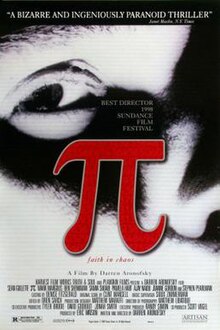
The first is the movie PI, named for the Greek letter which equals the ratio between the circumference of a circle to its diameter. But the movie is less about mathematics as it is a study in obsession, a visual representation of madness.
Pi isn't about the mathematical constant 3.1415926..., representing, among many other things, the ratio of the circumference of a circle to its diameter. The movie is about the deranged and beautiful quest of one person in search of the truth, the answer to the universe. The plot is a common one in science fiction: a phenotypic "aberration" in the brain causes the protagonist to develop special abilities that makes him sought after and feared. In this particular case, Max acquires a deep grasp of number theory. With his assumptions, that mathematics is the universal language, that number theory can represent everything in nature, and that there is a pattern in everything that occurs in this universe, he sets about trying to find it in the stock market.
After him are people who are interested in his stock market analyses for monetary purposes, and more strangely, a group of Rabbis who are convinced the same pattern of numbers is the key to their salvation. However, Max is the only one who can understand the semantics of the 216 digit number that is key to the universal lock. In the end, Max succeeds on his quest, but what he understands is never revealed to us. What he sees however is catalyst enough for him to inflict a lobotomy upon himself.
Today, many scientists are on the same quest that Max is, and most don't need to be as obsessed to find what they're looking for. As demonstrated several times over the course of humanity's existence, there is indeed an explanation for a lot of things we see in nature. That is, at least a conceptual level, there do exist patterns that can be written out as mathematical equations. This is particularly true given the discoveries this centuries involving relativity, quantum mechanics, and the subsequent biological and computing revolutions. But the search for the Grand Unified Theory continues.
Even though the movie isn't directly about Archimedes' constant, Pi is indeed an excellent solution to Max's problem. That constant is ubiquitous in our world today, popping up every so often, in a seemingly independent manner. Besides its strong presence in geometry, Pi appears in various equations throughout mathematics (especially certain infinite series) and even in places where you wouldn't necessarily expect it to at first intuition.
Unlike many independent films, Pi actually has a fairly coherent, albeit obscure, plot. The cinematography is excellent as well. Filmed completely in black and white, with obscure and surreal settings, the movie tries very hard to brings the audience to the edge of the abyss that is Max's mind.
It's protagonist, Max Cohen, believes that mathematics is the true language of nature and that every action in the world, no matter how random, is intricately ordered and patterned.
Given this thesis he decides to use this knowledge to try to predict the stock market. [SHOW: Scene 3, "state my assumptions]
The film goes beyond this initial premise and takes it to the plane of faith. Max is an agnostic Jew but he draws the attention of Lenny Meyer, a Jew from a sect involved in Kaballah, the Jewish mystical tradition. Lenny explains that the Hebraic language in numerical and replete with symbolism, with the key to the meaning of life. (SHOW: watch exchange scenes 9 and 10 Subway notes and Kaballah)
Max's computer occupies most of his apartment. When it crashes it leaves behind a printout of random numbers which he throws away. The question is: are these numbers the secret 216 digit number that the Kaballah sect is looking for?
The meaning of the number is clearly explained in this next clip (SHOW 31-35 Rabbi Cohen to the end)
This film is interesting because it starts out atheistic and orderly and shifts its tone; that maybe God exists and He could be explained thru science; until the stunning conclusion that perhaps God exists and is unexplainable.
Handmaid's Tale
Handmaid's tale (1990, Faye Dunaway, Robt Duvall, Aidan Quinn, Natasha Richardson). Based on the book of the same name by Margaret Attwood, this looks in the not too distant future in a "what if" situation. That being that the US becomes a theocracy. This is a science fiction look at what might happen if the right wing were actually to come into power. This is a case of commitment turning into fanaticism.
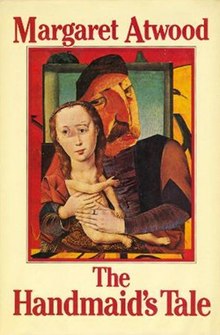

The scary part of it is that there is a movement, the Reconstructionist Movement it is called, in this country that transcends denominations but are agreed that the US should be governed by the Bible as interpreted literally. Many prominent ministers, including Rev. Criswell, the minister of the largest southern Baptist church in the country found in Dallas, think that women should not have the rights they do, that stoning should be the punishment for numerous offences following the Levitical laws of the Hebrew Scriptures. Bill Moyers was concerned enough about this movement he produced a two hour special on it a few years ago.
Today, Dominion Theology has similar notions—Raphael & Son Ted Cruz, et al are part of this movement!
In the opening scenes, we find Kate and her family trying to escape over the border into Canada. (SHOW opening scenes I and 2 "the lucky ones")
Here are a couple of scenes showing the brainwashing the women go thru followed by the ceremony which handmaids must endure.
The last scene we will look at is the extreme of fanatical power. When anyone disobeys what this theocracy has deemed as law. (SHOW scene 12, executions)
This movie relates mostly to the short story "Proselytes" and highlights the theological difference between Commitment and outright fanaticism. It can be a thin line
Ronald Farmer: "Theocracy"- Kindle, 2.99