Course: Science Fiction & Religion
Lecture #12: Apocalypse II
SRI AURUBINDO (1872-1950)
He is very popular in the U.S., especially among those interested in Eastern Religions. For our purposes, his evolutionary view of life is important, and I would not be at all surprised if A.C. Clark was very much aware of his philosophy.
For Aurobindo, matter is at the bottom of the evolutionary ladder, and Brachman, the absolute, is at the top. Right below Brachman is the Overmind, a place he believed we could reach while still alive. The reason for evolution is that the Spirit (Brachman) is pushing it forward. It is an evolution of consciousness.
Humans are on the level of mind but can have consciousness raised thru "integral yoga". These higher levels are beyond reason and are intuitive.
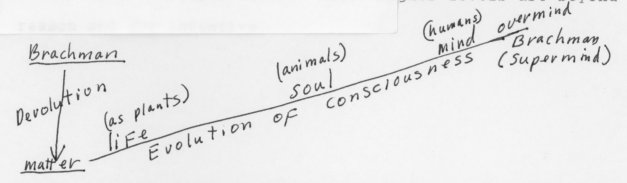
He has been compared to Tielhard de Chardin, the Jesuit who developed the idea of an Omega point to which we are evolving.
There is no question that Clark was probably aware of Aurubindo and certainly Tielhard. Aurubindo was educated in England.
NOTE: Highlighted section is “Additional Material – Read only if Time & Interest Permit
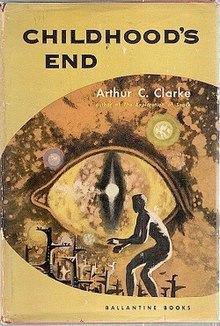
CHILDHOOD'S END
BY Arthur C. Clark, 1953
What appears to be several huge ships descend and sit over the world's major cities with the purpose of uniting the world and controlling it.
They bring security, peace and prosperity.
Most of the leaders of the world's religions sign a declaration of support for the rule of the overlords but it is not a unanimous opinion.
The main problem is the overlords allow no one to see them, even the UN sec. general who is the one communicating with them.
The overlords, as humans call them, tolerate all forms of govt. as long as it is not oppressive or corrupt.
After the sect. general is kidnapped and rescued by the head overlord, Kerallen, he decides to try to devise a way to see them since the main problem with people is this need.
He tries a plan with a flash gun but fails, However Kerellen tells him that in 50 years they will show themselves to humans.
Part II, THE GOLDEN AGE
50 years have passed, and the overlords reveal themselves to humans. It is also realized that there is only one ship, and Kerellen had used illusion to create what seemed like many others.
When he comes out of his ship, only a few people faint for he has leather wings, little horns, a barbed tail--ie the most terrible of all legends has come to life. It seems in racial memory they had come into violent conflict with humans’ eons ago.
This was a completely secular age with only a form of purified Buddhism-the most austere of all religions- surviving.
The overlords had on film all the past 5000 years of human history and it became obvious they were not all right. Within a few days all humankinds multitudinous messiahs had lost their divinity.
The fall of religion was paralleled by a decline in science--it seemed futile to search for secrets the overlords had already uncovered. The end of strife and conflict of all kinds also meant the virtual end of creative art.
The overlords are very interested in human psychology and psychic phenomena. A party is held. Jan Rodricks, a young black student of physics and astronomy, witnesses an overlord ship going into space and feels angry that the overlords have shut the door on research into flight in space. He notes the direction of the ship into the constellation, carina.
After the party several people participate in a Ouija board seance with an overlord watching. When it is finally Jan's turn he asks, "What Star is the overlord's sun?" it answers: NGS 549672
One woman Jean Morrel, faints. When the overlords discuss it, they believe Jean is the most important person alive and must watch her and Jan.
Jan finally gets a chance to check the star charts and discovers that NGS 549672 was right in the heart of the constellation carina. Thus he is the only one on Earth to know the origin of the overlords.
There was so much leisure, work week about 20 hours and doing what one wanted to do. Education was needed to overcome boredom. The abolition of armies and defense budget had doubled the worlds effective wealth and increased production had done the rest. sports and entertainment were the largest industries. The question now was "where do we go from here?"
Jan gets help from an oceanographer to build a self-contained capsule for him to stowaway in an overlord ship within the belly of a whale being shipped to their world.
It is 40 light years to their planet, but they can go 99% of the speed of light so only 2 months would pass for him going each way while 80 years would pass on earth.
Jan puts himself in hibernation for most the trip. After he leaves, Kerellan announces that there had been a stowaway, and it was Jan. He also says that there is no way he can stay there and in fact that humans cannot handle what they will find in space, thus the kibosh on space research -- "the stars are not for man."
Part III: THE LAST GENERATION
10 years after Jan has stowed away, Jean Morrel and her now husband George with son Jeffrey move to an art colony called New Athens. It was a protest against the overlords, but they did nothing to stop it. They practiced all the arts, drama, music, painting, writing, etc.
Their son Jeffrey has a strange experience during an earthquake when a voice tells him to run up a hill or he will be drowned by a tidal wave. As he does he runs into a huge rock and the voice tells him to move it. He does so with his mind.
The overlords visit the colony and research Jeffrey. Jeff tells his dad that he thinks the overlord was the voice that helped him on the beach.
George realized there’s more to it and they are being watched. Jeff, age 7, begins having dreams of a blue sun with a sulphur mountain. The overlords take notice.
He continues to dream every night, going further out into space each time. Finally, he dreams of a place outside the galaxy so the overlords know it won't be much longer.
They visit the family again and George knows Jeff must be seeing something real in his dreams. The overlords verify it.
His little sister, Jenny, begins the same path though she is just a baby. She progresses much more quickly. The overlords call this TOTAL BREAKTHROUGH.
The overlords were simply the midwives who helped bring about this breakthrough, though they themselves could not use any psychic power. They are caught in an evolutionary cul de sac. A race without a future.
Jeffrey got to where he no longer went to school and his dreams were not separate from waking existence.
Jenny, though a baby, had huge power, could remove food from the refrigerator and feed herself and in fact take care of all her own needs.
This metamorphosis infected the entire human race. It touched no one over 10 and under 10, no one escaped. Humanity lost its future, its children.
Kerallen makes his last speech to humans explaining that w/o their guardianship, the human race would have destroyed itself and other races unknown to them. Above all is the OVERMIND using both the overlords and humans like a potter uses clay.
The overmind is trying to grow and extend its powers and awareness of the universe. It is the sum of many races but long ago left the tyranny of matter behind. It is conscious of intelligence everywhere.
When the time is right the overmind triggers this transformation in a child where it then explodes and spreads to all children.
Kerallen needs to evacuate all those transformed to protect them from homicide, even by parents who don't understand what is happening. All the rest must simply live out their lives till they die.
Jan comes home after spending 2 months with the overlords which he discovered was dedicated to studying alien cultures like a huge museum.
As they approach earth Jan realizes there is no light from cities or anything else. Kerallen greets him an arrival.
Jan is shown what has happened to the children progressively thru the years. They don't sleep, or eat, or wear clothes or need food. They spent a few years in a strange dance and then stood still for years, never moving, oblivious to the seasons. or night or day. They are tied into the overmind.
Jan realized that the road to the stars was forked in two directions, neither led to a goal that included human hopes or fears.
At the end of one road were the overlords who preserved their individuality, independent egos, emotions, but were trapped. Their minds were much more powerful than humans but they were helpless and equally overwhelmed by the universe.
At the other end lay the Overmind, whatever it might be, bearing the same relation to man as man has to the amoeba. Potentially infinite, beyond mortality, it was absorbing race after race as it spread across the stars.
The overlords have been the tools of the overmind and Earth is the 5th race to be guided to transformation.
Jan is told that because of the fact time is nonlinear the future and past are one. so thousands of years ago humans glimpsed the overlords dimly and associated them with the end of humankind causing terror of their form and stories of Satan to arise.
Jan is literally the last man on earth since the rest had died out 10 years before his arrival. For about 6 years he lives his life especially playing Bach and filling his house with music to keep away loneliness.
One day he notices the moon has begun to turn on its axis and realizes the children are emerging from their long trance.
The overlords realize they must now leave but Jan decides to remain having realized that space is not for man. The overlords ask him to stay and keep reporting as long as possible what their instruments are reading.
He reports a great burning column over the western horizon, they are on their way to become part of the Overmind and leaving the last remnants of matter behind.
He sees what he thinks must be the overmind in colors and shapes, like the aurora borealis only more so. tremendous energy
He notices his weight decreasing along with gravity. Sees things rising into the air till anything not attached to Earth is going up, including the atmosphere. He feels an emotion of fulfillment and achievement.
Jan's last report: "Everything we ever achieved is gone up there into the stars. Perhaps that’s what the old religions were trying to say but they got it all wrong: They thought mankind was so important, yet we're only one race in -- do you know how many? Yet now we've become something that you could never be."
Then the Earth explodes leaving nothing as it feed its energy to the transformed children.
Kerellans mission is over but he feels sad that his race can't follow the same evolution. They serve the overmind because they have no choice but even in that service they would not lose their souls.
End of review
This is a much more positive view of the destiny of humans than most books dealing with the end of things. Clark is not a religious person but it is interesting that he sees human destiny much in the same way as some known mystics, such as we discussed.
Both Aurubindo and de Chardin believed humans are evolving in a spiritual manner. Much of the new age religions share this optimism.
Questions / Discussion:
- Is this realistic? or is this really just wishful thinking?
- Without help, or guardianship, such as the Overlords provided would humans be able to evolve, or would we blow ourselves to bits as much apocalyptic sf predicts?
- He calls the overlords a “cul de sac in evolution,” i.e., they can never evolve beyond where they are. Is it possible there are sentient races in the galaxy who cannot evolve spiritually?
- Or by definition does being sentient mean one has a spiritual evolution?
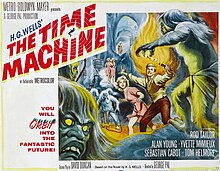
SHOW: Time Machine 1960 - clips - @ 20-25 min
Scenes 12-15 (10 min)
Scene 17 (5 min—can skip)
Scene 20 (4 min)
People still exist in 80, 271 - mutants (morlocks) live underground people (eloi) live above but like cattle.
SUMMARY OF THEOLOGY IN TIME AND SPACE
This course has attempted to show how religion or religious ideas are present in much of science fiction, even if the story is not specifically about religion.
Defining religion in the broadest sense, we dealt with ideas of How religion develops, ethics, what makes a being sentient, pseudo religion, concepts of a messiah figure, and apocalyptic, or the end of the universe or the world.
There are several things which I observed as I wrote this course that were new insights to me.
First, and probably the most obvious, is the fact that we are basically trapped in certain ways of viewing religion such that we project onto other planets and species religions similar to what we have here on Earth. In other words, it seems we are really not able to perceive something completely alien. In other words, we can't escape our own symbol system.
Second, it seems in the area of ethics that we are better able to visualize different understandings than we are in the concept of God. However, this is variations on a theme, such as in Half a life when 60 was decided as the age of resolution. This was to prevent people from living beyond their usefulness and is a problem currently being dealt with here.
Third, there were some creative ways of dealing with apocalyptic. Most of the stories dealing with the end of the world were typically post atomic bomb and thus saw the world ending in an atomic nightmare. Even Canticle for Liebowitz, though projecting it to the year 3780 or so, believed that would be the eventual end of the World. The second favorite end seems to be an asteroid or something, hitting the Earth.
Of course, and we didn't deal with this as it is technically not science fiction, many books see the end as the coming of Satan, or one like him and the biblical end with the four horsemen of the apocalypse.
I feel that Arthur C. Clarks stories had some of the most creative ideas in this area. The Nine Billion Names of God and Childhood's End both by him, had some great ideas. Particularly Childhood's End by seeing our evolution into something beyond the material followed the religious ideas of Tielhard De Chardin and Sri Aurobindo Ghose, both very popular today. In fact, more popular today than when the book was written in 1953.
Fourth, In dealing with the ideas of a Messianic figure some books are better than others. Dune is dealing with a Mahdi as the "man on the white horse" so to speak. Paul Maud dib is a catalyst for the Freman. However, the Jihad started by them is out of his control so in this sense he is not their leader.
In Lord of Light, we have a Buddhist vs Hindu vs. Christian with Sam, the Buddhist, winning out and being recognized as the messiah. This of course, reflects the writer’s own prejudice, I believe, but also the reality in India.
It is with Stranger in a Strange Land that we have the most influential book dealing with a messiah figure. This book touched a chord far beyond the sci fi genre. Its timing, message of trustworthy communication and honesty met a cultural need.
CONCLUSIONS;
Science fiction that lasts and is really popular is not just stories in space with high tech weaponry and gadgetry. That part is fun and helps the story but what really makes some sci fi popular, I believe, is it touches a sociological and religious need or desire in the culture of its time.
For example, the most obvious examples are Star Wars and Star Trek. What is it that makes them so great? Basically Star Trek was not afraid to take on ethical and social problems and foresee a future in which we would not end ourselves in an atomic holocaust but rather solve our problems and have real peace and prosperity. The Alien races in Star Trek and in science fiction are reminiscent of the gods, angels, demons and fairies of legend and are often gifted with supernatural powers and abilities.
This is true for Star Wars as well. The mystical elements are very overt in this classic story of good winning over evil. The Force, like the Tao of Chinese religion, permeates everything. The son who saves the father is among other great themes of mythology.
It is interesting to note that in the late 40's and 50s the culture was basically optimistic, we had the bomb and were invincible. However, science fiction from this era was basically pessimistic, seeing a horrible end because of the bomb.
In the 60's, 70's and 80's, science fiction became more optimistic, Dune, Stranger, Star Trek and Star Wars, etc. while the society as a whole became more pessimistic. It is almost like science fiction is a mirror reflecting religious and cultural needs of each era.
For some people, science fiction fandom is meeting a religious need. In Gnosis magazine for the summer of 1994, it points out that for many people traditional religion is no longer meeting a need but by projecting onto the future the sacred is not lost, it is honored in new forms which the theologians and philosophers don't recognize yet as holy. The eternal return of the past has given way to an aspiration toward the future onto which we project the same ideals that inspired traditional religion.
Scientology, founded by SF writer L. Ron Hubbard, has not had good press is a good example of a religion combined with SF. It involves initiations that start as an alternative form of psychotherapy and go on to recover "memories" of ancient galactic intrigues from earlier incarnations. Again, the mythic past is reinterpreted in futuristic terms.
There are UFO sects such as Unarius, that are plainly religious and resemble secret societies in inverse. They know the secrets of the spiritually advanced aliens. These groups received a boost from "Close Encounters of the Third Kind".
There is still a group based on Heinlein’s "Stranger in a Strange Land" called the Church of all worlds. It is an expression of post hippie paganism with a large membership drawn from myriad witchcraft traditions as well as SF fandom. There "nests" practice ritual magic and "polyamory" and they publish a magazine called "Green Egg". Unlike UFO cults and scientology, the Church of all worlds knows they are based on a work of fiction. They treat Heinlein’s' novel as an expression of important ideas, not as prophecy of a coming Martian Messiah.
Thus, if communism, fascism, and other secular movements are in a sense "religions", then so is fandom, with its holy books, infallible prophets, and antagonism towards noninitiates. The shamanic initiations of the past replaced bones and tissue with crystal; now the android, or cyborg fulfills the same transhuman role.