Course: Eastern Religious Traditions
Lecture #10: Buddhist Schools in China
Buddhism represents the first major foreign religio-philosophical tradition to penetrate and seriously influence Chinese Religious and cultural outlook.
Buddhism in both its forms (Thervada or Hinayana and mahayana) promoted an essentially Indian view of life and reality which both contradicted the Chinese understanding and also amplified it.
Buddhism contradicted Chinese interpretations of existence by generally regarding the common world of human experience as a delusive product of passion-infected minds.
Emancipation came apart from social life. Monasticism and the rigorous disciplines to control the mind and passions inducing an awareness of the voidness of things, leading to detachment, tranquility and ego-lessness.
The individualistic character of the Buddhist quest for enlightenment collided sharply with the Chinese sense of social or communal obligation and filial piety, as well the positive acceptance and enjoyment of this world.
One outcome of this interaction was a synthesis of the two views (Chinese and Indian) in distinctive forms of Chinese Buddhism (such as Chan) advocating acceptance of this world and supporting participation in it.
Buddhism broadened the scope of Chinese understanding of human destiny thru concepts of karma, transmigration, and mythical cosmology.
The moralism of the karmic system fitted well with Confucian social concern. Confucian tradition showed little concern for the common people and their hopes so it was mainly Buddhism which attempted to console ordinary people with hope for their future well-being beyond this life
On the popular level Buddhism resembled religious Taoism which could confer benefits of long life, good luck, and help in misfortune by means of magical power. Buddha was early ranked with the Yellow Emperor (Huang-ti) and Lao-tzu an important divine personage.
Buddhism appealed not only to the popular masses but to the higher levels of society. Cultured individuals who yearned for freedom and release from worldly burdens resulting from the collapse of the Han empire (C. 220 CE). Along with the resurgence of interest in Taoist philosophy, the life of retirement and withdrawal afforded by Buddhist monasticism invited the gentry of that time.
Buddhist teachers took advantage of the similarities between Buddhist and Taoist metaphysics through a practice of matching or paralleling terms rendering Buddhism more intelligible to the Chinese mind.
These efforts of early Chinese Buddhist to commend Buddhism to the Chinese people worked for a while but more accurate translations of the Buddhist texts and more complete study revealed the basic differences with Chinese thought. As a result, many Taoist and Confucian spokesmen criticized and challenged the religious and social implications of Buddhism in order to advance their own religious or social interests.
Taoists charged that Buddhism was inappropriate for Chinese society because of its foreign dress, ritual, and burial customs as well as its strange rules for food and family. They objected to Buddhist celibacy, use of impure materials for medicine, and begging.
Taoists followed Confucianists in criticizing the unproductive labor and wealth of the monks. Forged texts and misrepresentation were widely used on both sides.
The Confucianists had two main objections.
They claimed that Buddhism was contrary to the basic pattern of ruler-subject relationship and
The existence of a class of nonproductive priests meant less revenue for the state.
Buddhism was charged with the decline of the government and society and had to be rooted out. This became the pretext for persecution.
Intellectual objections centered on the existence of the soul and transmigration which the Confucians denied, mainly on the ground that this opened the people to exploitation. Confucianists were interested in ideas which had social unity.
Buddhists counted these criticisms by maintaining that philosophically Buddhism was universalistic while Taoism and Confucianism were inferior in being concerned only with this world and its petty affairs. The interdependence of all beings taught in Buddhism reduced selfishness and competition, according to them.
While these attacks were substantial, Buddhism spread among the people by offering glorious salvation and many benefits. Persecutions were frequent but short lived because of the support of the common people who made the rulers relent.
The Buddhists engaged in social work and contributed to the economy of the country thru its rolling mills, oil processing facilities, hostels, and the inexhaustible" treasury used for welfare. It brought medicine to the poor, aided sick and starving, built roads, wells, bridges, and planted trees.
Buddhism grew in the face of bureaucratic and official opposition, appealing to the common man with compassion and to the intellectual with a profound vision of wisdom and spiritual emancipation.
The schools
Divides into two periods. The initial period was called the age of the Six Schools and Seven Branches. During the second stage these became more distinct and well-defined.
The first scholarly movement had two basic interests: meditation and wisdom (Prajna). Influenced by the contemporary ascendancy of Neo-Taoism there was a concern for the nature of ultimate reality and its relation to things.
During the second period in the T'ang age (618-907 CE) ten schools emerged. Five were distinctly Indian and did not have much overall influence. The other five were more in line with the Chinese spirit and have had wide influence in Japan as well as China.
The transformation of Indian Buddhism into Chinese Buddhism involved a reinterpretation of Indian ideas. Seng-chao, a famous Madhyamika teacher, said "Reality is wherever there is contact with things.” This statement contrasted with the Indian emphasis on the delusive character of the world motivating withdrawal.
Chinese Buddhists were critical of the Indian tradition for attempting to abolish the spiritual domination of the world over man by doing away with the world. For the Chinese, wisdom was not divorced from the things of the world but rather wisdom revealed their true nature.
Seng-Chao declared: Hence the sage is like an empty hollow. He cherishes no knowledge. He dwells in the world of change and utility, yet he holds himself to the realm of non-activity (wu-wei). He rests within the walls of the nameable yet lives in the open country of what transcends speech. He is silent and alone, void and open, where his state of being cannot be clothed in language. Nothing more can be said of him.
Thus, Buddhism, with reminiscences of Taoist terminology, took up the cause of world affirmation.
Hua-yen
One of the most influential philosophies in Chinese and Japanese Buddhism. It not only synthesized major philosophical currents in Mahayana thought, but it had a universal vision of mutuality within the whole.
Fa-tsang (643-712) developed the system based on the hua-yen sutra. His idea was that all views are false because all views are true.
Every single view is false
Views held together are true. Tathata means suchness, reality is all views held at once.
Reality is all views held at once, but one can only hold one view at a time. Example: a glass of water is H2O, it quenches thirst, it is molecules in motion, etc.
However, reality is everything at once, will talk as if there is nothing real, and also about everything being real.
The ultimate teaching of Buddhism according to Fa-tsang is the principle of the mutual interpenetration of all things as a result of their being manifestations of the one, all-embracing Buddha-mind.
One attains Nirvana (the solution) by realization that everything interpenetrates everything else.
Won't get there by reasoning but Hua-yen emphasizes study and reason however, you must end up having an intuitive experience thru your meditation.
The goal of Hua-yen was to get a view of reality so could live in this world, not escape it (world affirming), in a direct, harmonious way. Reality is totality, the change is in the way one sees reality not outside of us but inner understanding. The way to see the world correctly is with the Buddha mind which is always enlightened and is the highest reality.
The Tien-t'ai school taught virtually the same thing as Hua-yen. Its contribution was to develop a comprehensive historical doctrinal organization of Buddhist texts and doctrine covering Buddha's lifetime which set the pattern for later thought in Chinese and Japanese Buddhism.
Correlated with the different periods of Buddha's life and teachings they developed a set of criteria for distinguishing various forms of doctrine with the aim of showing the superiority of full Mahayana teaching over earlier Hinayana or elementary expressions of Mahayana philosophy.
Like Hua-yen it expressed the theory of "three thousand in one moment (or instant) of thought" and proclaimed that everything is the essence of every other thing from the standpoint of ultimate reality.
Consequently, this philosophy also asserted the importance and reality of the things of this world as embodiments of the universal Buddha-nature.
Ch'an School
Appeared as the culmination of several trends within Chinese Buddhism. It combined with Taoist iconoclasm and was in a measure a reaction to the scholasticism and lifeless formalism of T'ang Buddhism.
It tried, thru meditation, to bring to full practical and experiential realization the principles of universal Buddha-nature and instantaneous enlightenment.
It also focused attention on life in this world, fusing with Taoist love of Nature. Emphasis on ego-lessness and nonduality (Buddhism) together with the resulting qualities of naturalness and spontaneity (Taoism) achieved the complete assimilation of Buddhism within the Chinese Spirit.
Term Ch'an or Zen was derived from the word dhyana which in Sanskrit means "mediation". Ch’an claimed to be the most essential aspect of Buddhist life.
Indian yoga techniques provided the basic elements for this endeavor. Went under modification in its adaption to Chinese ways. Influenced by Taoist nature mysticism and Chinese interest in this life, meditation aimed at instantaneous enlightenment. Chinese Buddhists aimed at realizing their fundamental identity with the absolute reality surrounding them in the world of nature rather than bringing a halt to discursive thought.
Many schools developed all claiming to transmit the true doctrine and practice of Ch'an. The Northern school maintained a gradualist approach to enlightenment, while the southern school emphasized instantaneous enlightenment. These two schools became the main stream of tradition to present schools in Japan with Rinzai (sudden enlightenment school in Japan and most popular in the U.S.) using Koans or riddles with shocking or no answer used to jar the person out of the usual way of seeing reality. ex: what is the sound of one hand clapping?
The Sound of One Hand
(from The Gospel According to Zen p.77)
The Master of Kennin temple was Mokurai, Silent Thunder. He had a little protégé named Toyo who was only twelve years old. Toyo saw the older disciples visit the master’s room each morning and evening to receive instruction in sanzen or personal guidance in which they were given koans to stop mind-wandering.
Toyo wished to do sanzen also.
“Wait a while,” said Mokurai. “You are too young”
But the child insisted, so the teacher finally consented.
In the evening little Toyo went at the proper time to the threshold of Mokurai’s sanzen room. He struck the gong to announce his presence, bowed respectfully three times outside the door, and went to sit before the master in respectful silence.
“You can hear the sound of two hands when they clap together,” said Mokurai. “Now show me the sound of one hand.”
Toyo bowed and went to his room to consider this problem. From his window he could hear the music of the geishas. “Ah, I have it!” he proclaimed.
The next evening, when his teacher asked him to illustrate the sound of one hand, Toyo began to play the music of the geishas.
“No, no,” said Mokurai. “That will never do. That is not the sound of one hand. You’ve not got it at all.”
Thinking that such music might interrupt, Toyo moved his abode to a quiet place. He meditated again. “What can the sound of one hand be?” He happened to hear some water dripping. “I have it,” imagined Toyo.
When he next appeared before his teacher, Toyo imitated dripping water.
“What is that?” asked Mokurai. “That is the sound of dripping water, but not the sound of one hand. Try again.”
In vain Toyo meditated to hear the sound of one hand. He heard the sighing of the wind. But the sound was rejected.
He heard the cry of an ow. This also was refused.
The sound of one hand was not the locust.
For more than ten times Toyo visited Mokurai with different sounds. All were wrong. For almost a year he pondered what the sound of one hand might be.
At last little Toyo entered true meditation and transcended all sounds. “I could collect no more.” He explained later, “so I reached the soundless sound.”
Toyo had realized the sound of one hand.
Soto Zen which in Japan is the gradual enlightenment school and most popular there believes one is being enlightened while meditating.
Merit in Ch'an Buddhism meant inwardly to see the Buddha nature; outwardly, practice reverence." They rejected externality and formality and made no difference between rich and poor, etc. since the Buddha nature is the same in all things and people.
Example: Ox herding pictures
The Ox Hearding Pictures [Wikipedia Article]
These series of pictures try to show the process of enlightenment by comparing it to ox herding.
These are by Jitoku and though Japanese, are appropriate here as the ideas began in China.
One must know what each thing means to understand the pictures
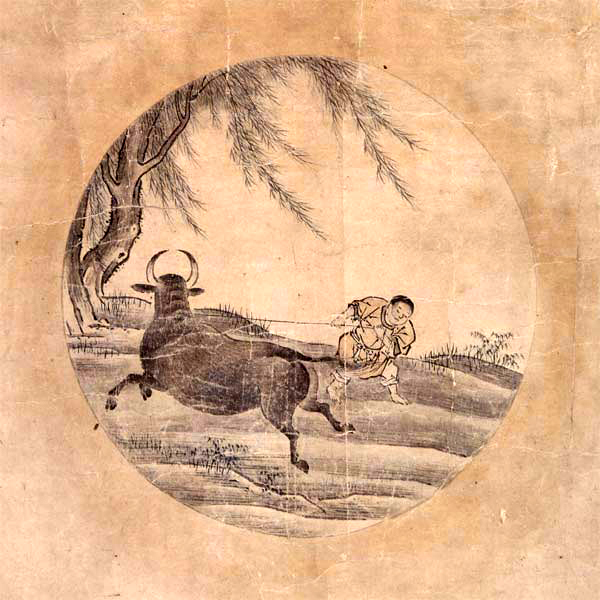
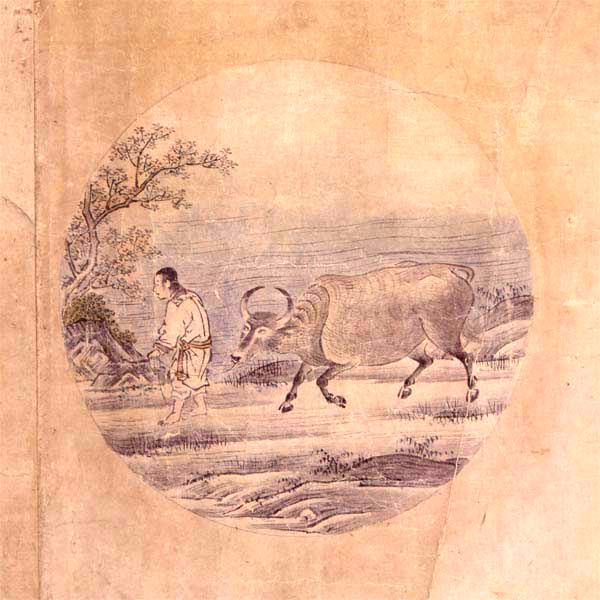
The Ox is the mind ox, i.e., the thoroughly pure and immaculately white mind ox. The True Mind, the Buddha Nature that is in everything. The ox begins as black as it means the dark clouds of human attachment, discrimination, delusion, ignorance, etc. that needs enlightenment.
The Herdsman is separated from the ox as one’s ego is separated from our True "Buddha Nature" because of all the above. Gradually the ox is tamed and the herdsman and ox become one.
The Tether of Faith. Humans can reflect and realize how ugly and weak we are. Thus Faith means the aspiration for the joy of awakening in the eternal and the absolute, the happiness of losing the self in the Buddha.
The Rod of striving in the hand of the herdsman indicates the will, effort and courage which are essential if we are to accomplish anything. Everyone contains the Buddha nature like a gem buried in the earth. It will forever remain hidden unless we make the effort to break the darkness of our deep-rooted ignorance and reveal the light of the white ox.
Circle: Three circle, in which all the pictures are drawn, represents a thoroughly polished mirror. It is not a void but is full of the absolute power to reflect everything. It represents the True Mind or True nature.
The true mind and the true nature within ourselves, or spirituality itself, is ever existent regardless of the state of our mind, whether enlightened or ignorant. Pic. 5 is enlightenment
One Buddhist monk, I-Hsuan (d. 867 CE) said the essence of Buddhism is the natural way of life. he said:
"Seekers of the Way. In Buddhism no effort is necessary. All one has to do is to do nothing, except to move his bowels, urinate, put on his clothing, eat his meals, and lie down if he is tired. The stupid will laugh at him, but the wise one will understand. An ancient person said, "One who makes effort externally is surely a fool.’"
I-hsuan also showed how radically he rejected obstructive attachment to externals in his demand to his disciples to:
"kill the Buddha if you happen to meet him. Kill a patriarch or an arhat if you happen to meet him. Kill your parents or relatives if you happen to meet them. Only then can you be free, not bound by material things, and absolutely free and at ease."
There were five basic principles which emerged as a guide to a basic way of life in Ch'an. These principles emerged in stories used in training monks as the basis of meditation.
The first principle, "the highest truth or first principle is inexpressible," indicates that Ch'an strives for an experience of reality beyond words and is not satisfied with conceptual knowledge only. This experience is called Void because it cannot be defined, but it is also called Buddha-nature or Original-nature as a symbol of union with the root of our being. Buddhist philosophy is one of experience, i.e. self-evident experience. Thus they will not talk about it but say 'try it yourself."
The second principle is that "spiritual cultivation cannot be cultivated.” This paradoxical assertion emphasizes the fact that religious endeavors which may begin on the conscious level must eventually be made second nature and part of the instinctive, spontaneous reactions of personalities. When one gets here he does not ‘practice Buddhism'; one is in his deepest nature Buddhist. The conquest of conscious goodness ends competition in the religious life.
The third principle, that "in the last resort nothing is gained,” means that the world is not abolished nor are We transferred to another realm, but our understanding is transformed.
"When I began to study Zen, mountains were mountains; but when I thought I understood Zen, mountains were not mountains; But when I came to full knowledge of Zen, mountains were again mountains."
The fourth principle states: “There is not much in Buddhist teaching." This simple means that concepts, doctrines, and words are inferior to the experience of enlightenment itself. From the highest perspective there is really neither Buddha, Buddhists, nor Buddhism. If one perceives Buddha over against himself, he is still caught in the net of discriminating abstractions, thus I-hsuan's instructions if they meet Buddha, they should kill him. The whole attempt of Buddhist discipline, generally, is to actualize in experiencer what is learned in concept. Person to person contact is needed not just scriptures.
The fifth principle declares that "in carrying water and chopping wood: therein lies the wonderful Tao.” The idea is that enlightenment is not itself confined to definite practices but may come instantly in the course of carrying out the most menial tasks. As the world is the world, and Buddha-nature is universal, one may realize it anywhere. Thus, Ch'an has had extraordinary influence in art.
Ch'an stresses one's inner and ultimate identity in deep interpersonal relation with others. Artificialities are to be swept away. The emphasis on the validity of daily life as the sphere of ultimate reality and meaning also supports the individual in his quest for self-understanding.
This is the main reason for its appeal in the present day and in the West,
The Pure Land School
Pure land tradition attracted the popular masses thru its offer of a simple way to salvation through reciting the name of Amitabha Buddha (Chinese O-mi-to-fo, Japanese Amida).
The faith and practice of recitation would permit the individual to be born in the Pure Land, (the western paradise ruled over by the bodhisattva Amitabha), from which state he would eventually be assured the achievement of Nirvana or realization of Buddhahood.
The Pure Lands in Buddhist mythology was created by Amitabha Buddhas as the result of his vows to save all sentient beings and the infinite merit he acquired thru eons of practice.
In the Chinese mind it represented a glorious heaven beyond the travail of this world and was accessible by reciting the name of Amitabha in faith.
These teachings coincided with belief in heavens and the quest of immortality which had developed in religious Taoist tradition.
T'an-luan (476-542 CE) was responsible for the popular development of Pure Land ideas. He was from North China which was infiltrated with magical religion. While looking for an elixir of immortality after a long illness, he ran into a Buddhist monk who convinced him that true everlasting life was attained thru Pure Land teaching. He thus cast aside his Taoist texts and became a teacher of Pure Land doctrine.
He popularized Pure Land doctrine by joining it to the theory of the decline of Buddhism. According to this theory the purity of the Buddhist order, doctrine and discipline and the ability to achieve enlightenment decreased as the inspiration of the Buddha's receded into the historical past.
Finally, the last or third, age called the age of Mappo, had come in which no Buddha was present and extremes of egoism, passion, stupidity, anger, pride and doubt dominated human life. Tho the doctrine was taught, no one could attain Buddhist ideals. Thus T'an-luan held that ordinary mortals could achieve salvation through the recitation of Amitabha name.
This way was designated the easy" way in contrast to the 'difficult" ways of meditation and austerities of earlier Buddhism.
The evolution of Pure Land teaching coincided with the Chinese tendency to affirm life in this world, despite its other-worldly emphasis, because it opened the doors of salvation to the lowliest common man.
Buddhism in Chinese Society.
As Buddhism spread thru Chinese society it met sporadic opposition from both Confucian and Taoist exponents who regarded it as not good to the health and progress of Chinese society and culture. Result was that Buddhism was constantly under the surveillance of the state even when officials patronized the order for the sake of merit.
The result of these conditions was to keep Buddhism institutionally weak but not to interfere with its permeation of the masses.
The persecution of Buddhism in 845 CE, which was most severe and damaging, signaled the end of Buddhist influence on the higher levels of society.
Confucian knowledge had begun a revival and Confucian scholars eventually displaced Buddhist intellectual leadership.
In contrast to the other-worldly and mystical tendencies of Buddhism, the Confucianists stressed practical efforts in the world.
Ch'an emphasis on practice and discipline and its anti-intellectualism limited efforts to educate monks and contributed to the waning intellectual influence of Buddhism, Buddhist scholarship did not progress beyond the lines established by the major schools of the T'ang era.
Also, when Buddhism lost prestige among the wealthy classes it also meant a loss of income. There was more government control though it was allowed to spread when it aided in pacifying the people. The aspects of asceticism and other-worldliness were made to conform to Chinese interest in this world.
Nevertheless, Buddhist influence in Chinese society and culture has been extensive thru its two thousand year history, and can be discerned in language, popular ideas, beliefs about afterlife, festivals, arts, literature and philosophy.
Buddhism as a specific faith became relegated to a popular religion on the level of religious Taoism with which it generally fused.
Buddhas and Bodhisattvas together with Taoist deities became the protectors of the common people.
Buddhism became largely associated with the performance of funerals. It developed masses and memorials for the dead.
Such celebrations enabled Buddhist to fulfill filial piety demanded by Chinese morality.
Some positive features included the coming of printing which aided the dissemination of Buddhist texts.
The founder of the Ming dynasty (1368-1644 CE) had originally been a Buddhist. He placed Buddhism under strict regulation, knowing its hold on the masses, but also reorganized the order, building and repairing temples, and contributing to the publication of the canon of scriptures.
There were also Buddhist scholars who advocated the unity of the three teachings of Buddhism, Confucianism and Taoism as well as combining Ch'an and Pure Land teaching. They also developed a defense against Christianity.
Under the Manchus (1644 CE) in the Ch'ing dynasty, Buddhism suffered from oppression and strict control under the influence of Confucian orthodoxy.
The T'ai-ping rebellion (1864 CE) resulted in a great destruction of Buddhist temples in southern China.
In modern China Buddhism has suffered from widespread misrepresentation by Christian missionaries, Chinese Confucianists, the Japanese and Communists.
The Christians regarded Buddhism as superstition and the priests lazy and ignorant.
The Confucianists looked on it as parasitic.
The Japanese tended to despise it as inferior to their own forms.
The Communists saw it as exploitive and reactionary to social and political progress.
In the present situation the future of Buddhism in China hands is in doubt. Though initially rejecting religion in 1949, the 1954 constitution guarantees freedom of religion. However, the communist regime has seized property and forced monks in great numbers to become laymen and join the work force.
However, unlike its treatment of Christianity, the Chinese communists have recognized the cultural contributions of Buddhism and its utility as an instrument of foreign policy in dealing with the Buddhist countries of Asia.
They have maintained the Chinese Buddhist Association which engages in studies of Buddhist tradition as well as serving as spokesman for government policy to Buddhists outside of China.
Whether the Buddhist spiritual outlook can survive in complete subjection to a secular political order still remains to be seen.